

Tools and providers
Selecting multilingual social tools by task, evidence and the cost of leaving
Select multilingual social tools by task, evidence and exit controls, while keeping language quality, accessibility and UK legal checks independent.
Multilingual social marketing tools and providers should be selected for a defined job, not bought as an all-purpose language stack. Translation workflow, language quality assurance, social publishing, accessibility checking, participant research, analytics, asset control and project records are different functions. A product that performs one of them well has not thereby solved the others.
For an organisation operating from England, the useful first decision is modest: describe one source asset, one self-described audience language and format need, one channel, one approval route and one reversible release. Then decide whether the existing manual process is adequate.
New software is justified only if it improves a recorded control without weakening language review, access, security or exit.
This guide uses public records checked on 6 September 2026. Supplier pages report suppliers' claims about their products, not independent tests, UK legal clearance, or evidence a feature is in a buyer's precise edition.
No price is reported: public pages did not establish a complete England-buying basis. That basis needs currency, VAT, billing period and commitment. It also needs usage, support and exit.
What to take away
- Choose multilingual social tools for one defined job, not as an all-purpose language stack.
- Justify new software only if it improves a recorded control without weakening language review, access, security or exit.
- Public supplier pages confirm feature claims on a stated date but are not independent tests or legal clearance.
- Never infer a person's language from a name, postcode, ethnicity code, browser setting or profile clue.
- Treat the manual baseline as a real option and reject it only for the same failures you would reject a product.
- Begin selection with one content decision, not a supplier demonstration.
- Give each function an acceptance artefact and record the no-purchase alternative on the same workload.
- Note supplier, product, data location, export and deletion fields; mark missing items unknown.
- Test with invented copy and dummy records; accept only if export returns the full record set and deletion leaves dated proof.
- Treat translation, language review, subject review and accessible rendering as separate gates.
Split the work before making a shortlist
Map the content path from request to deletion. Give each step an input, output, owner and acceptance test.
Tool functions and evidence limits
Function
- Translation workflow
- Files, terminology, reviewers, export
- Language QA
- Versioned rules, flagged segments
- Social publishing
- Account, permission, preview, approval
- Accessibility checking
- Automated plus manual checks
- Research and surveys
- Sampling, consent, withdrawal route
Evidence needed
- Translation workflow
- Competence or cultural suitability
- Language QA
- Meaning, tone, accuracy
- Social publishing
- Legal acceptability, comprehension
- Accessibility checking
- Accessibility from badge alone
- Research and surveys
- Representativeness, preferred language
Cannot prove
- Translation workflow
- Language QA
- Social publishing
- Accessibility checking
- Research and surveys
Split the work
| Function | Bounded task | Evidence needed before acceptance | What the tool cannot prove |
|---|---|---|---|
| Translation or localisation workflow | Route an approved source caption and brief through a controlled target version | Source and target files, terminology record, named reviewers, status history and export | Professional competence or cultural suitability |
| Language QA | Detect agreed terminology, number, placeholder or omission problems | Versioned rules, flagged segments and human disposition | Meaning, tone, subject accuracy or audience preference |
| Social publishing | Place the approved version on a specified account at an authorised time | Client-owned account, permission log, preview, approval and live-render record | Legal acceptability, comprehension or commercial effect |
| Accessibility checking | Examine the actual asset, landing page and user path | Automated findings plus manual keyboard, screen-reader, contrast and language checks as relevant | Accessibility from a badge or automated scan alone |
| Research and surveys | Present equivalent participant information and questions | Sampling frame, consent record, language version, withdrawal route and response export | Representativeness or a person's preferred language by inference |
| Analytics | Preserve defined events and denominators for an agreed period | Metric card, source query, timezone, exclusions and reconciliation | Causation or an England-wide benchmark |
| Asset and version control | Keep approved source, target and creative versions together | Immutable identifier, rights record, approver, expiry and rollback copy | That the latest file was actually published |
| Project records | Show requests, decisions, incidents and closure | Decision log, timestamps, owners and retained evidence | That a workflow was lawful or effective merely because it was logged |
Do not populate a language field from a name, postcode, ethnicity code, browser setting or profile clue. Ask people how they want to receive information where the interaction permits it, and document the purpose for which that answer is used. Professional translation, native-level review for the relevant variety, subject review and accessible rendering remain separate acceptance steps.
Research, analytics, asset control and project logging each need their own purpose, permissions and retention.
Establish the no-purchase baseline
A small team may be able to run one controlled campaign with buyer-owned folders, an asset register, a terminology sheet, role-based access and a ticket log. Treat this as a real option, not a straw man. Record the staff time, error exposure, recovery method and evidence quality in the same units used for a software option.
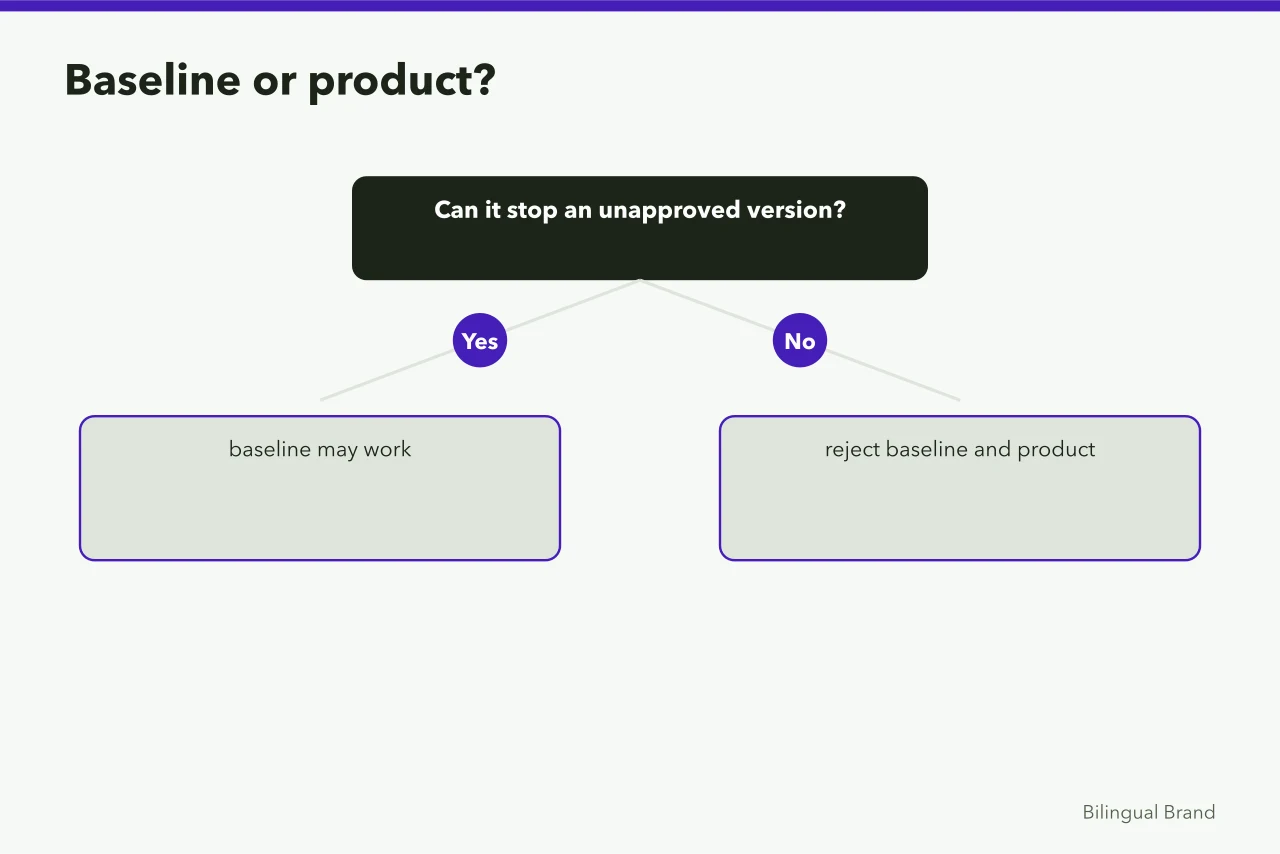
Reject the baseline if it cannot stop an unapproved version, show who released an asset, recover after an account problem or export the buyer's language assets. Reject a product for the same failures. A dashboard does not compensate for weak source ownership, and automation does not compensate for missing review competence.
Document the baseline with controlled folders, a register and named reviewers. Compare it with software on the same workload, evidence quality, recovery and exit units. If a licence adds dashboards without solving the defined failure, it is not a relevant improvement.
Build the evidence file
For every candidate, record legal supplier, exact product, edition or plan, deployment, geography, source date, user and usage unit, support, renewal, data location, subprocessors, export, deletion and contract route. Unknown means unknown. A reseller page or review score does not fill a missing first-party field.
A workable export route means CSV, XLIFF and JSON downloads for source and target strings, plus a record-level manifest and a deletion certificate. The manifest lists asset ID, language, reviewer, approval timestamp and version. The certificate gives request date, systems covered, residual backups and retention end date.
| Candidate | Screening type | Typical pricing unit | Export and record fields to test |
|---|---|---|---|
| memoQ TMS | Managed translation management | Quote; per user or project | Versioned source and target; terminology; role history; export |
| Smartcat | Translation management | Self-service; per user or project | CSV, XLIFF and JSON; record manifest |
| Crowdin | Localisation platform | Published plans; per project or word | CSV, XLIFF and JSON; record manifest |
For the worked example, test Smartcat first for self-service export. Test Crowdin next if its published plan matches the workload. Keep memoQ TMS for a quote-based managed TMS. Reject any candidate that fails the export and deletion test.
Read supplier evidence narrowly
Public product pages can confirm a named feature claim on a stated date. For example, current memoQ product documentation identifies memoQ TMS as a translation-management product and distinguishes browser interfaces and related components. Smartcat's own TMS page describes workflow, human-review routing and exchange-format import and export.
These are global supplier statements. Neither establishes that an England buyer's files, languages, integrations or approval design will work without a configured acceptance test.
Edition matters: memoQ's cloud plan lists Starter, Essential, Professional and Premium plans, but availability and terms vary, and Smartcat's public page names Adapt and enterprise tiers, yet a dated order form is required.
Supplier evidence to log
- Legal supplier, product, edition, deployment
- User and usage units, currency, VAT
- Term, renewal, support, overage, termination
- Mark missing fields unknown, never fill
Social publishing evidence has the same boundary. The Hootsuite plan comparison differentiates Standard, Professional, Advanced and Enterprise, including account, collaboration and approval claims. Hootsuite's privacy explanation says its content is hosted in United States data centres and connected services have their own terms. Those statements prompt transfer and contract questions; they do not answer them for the buyer.
Research software requires its own test. Qualtrics explains that its survey translation capability is limited to certain licences and that one survey can contain multiple language versions. Its broader language record also warns that machine-generated translations may be inaccurate. Do not treat a supported language code as proof of equivalent information, valid consent or accessible participation.
Accessibility claims need an equally strict boundary. WAVE says its evaluation suite can identify many web-content issues and facilitate human evaluation. Its own limitations page states that an automated tool cannot determine that a page is accessible. Social-media rendering, captioning, text alternatives, keyboard paths and linked landing pages still need manual checks with the relevant language and assistive technology.
Apply independent gates
Procurement should not collapse risk into one weighted score. The following are pass-or-hold decisions:
- Language and subject quality.Supply the source, terminology, prohibited wording, target variety and claim context. Require a suitably qualified translator or language professional, a native-level reviewer appropriate to the assignment and a subject specialist where claims carry technical, medical, financial or other material risk. One person may hold more than one competence, but the evidence must show each role.
- Equality and accessibility.Test the delivered asset and route, not just the authoring interface. For covered public-sector services, GOV.UK's accessibility requirements explain the statutory framework. Other organisations still need qualified equality and accessibility review appropriate to their duties and users.
- Privacy and PECR.Write the data map for source files, user accounts, participant responses, audience uploads, tracking and support access. The ICO's direct marketing guidance requires organisations to identify direct marketing, plan from the start and respect people's preferences. It does not select a lawful basis or PECR route for a campaign. A named UK privacy and PECR reviewer must assess the current law and facts, including audience uploads, tracking and later direct marketing.
- Advertising and consumer claims.Preserve the approved meaning, qualifications, evidence and relationship disclosure in every language and format. Platform approval or a generated translation is not claim substantiation.
- Intellectual property.Record rights in source copy, terminology, translation memories, target text, images, fonts, audio, training material and generated output. GOV.UK's copyright guidance gives the general UK boundary; an IP specialist must analyse the actual licence and use.
- Safeguarding and people.If work involves children or adults at risk, stop until a named safeguarding lead approves the design. Separately confirm employment or contractor status, confidentiality, supervision and fair access for translators, reviewers and researchers.
- Security and continuity.The NCSC advises buyers to understand what must be protected, who suppliers and subcontractors are, and what access they receive in its supply-chain principles. Obtain current evidence for identity, access control, logging, incident notice, backup, recovery and supplier dependencies.
- Commercial, procurement and finance.Confirm authority, conflicts, rebates, service units, support clocks, change control, taxes, renewal and exit. Public buyers should map the relevant procurement regime. The current Language Services agreement is an official route with defined lots and dates, not proof that a particular call-off, supplier or tool meets this project.
A pass in security cannot cure an inaccessible participant route. A professional translation cannot cure missing rights. Keep the decision record capable of showing which specialist approved which question and on what evidence.
Test with synthetic material before live content
Build a non-production pack containing invented copy, dummy names, non-sensitive images, known terminology traps, right-to-left or character-rendering cases where relevant, deliberate accessibility defects and a rollback version. Do not upload real audience data, confidential creative or personal information to a trial.
Synthetic test sequence
- Build non-production pack with invented copy
- Run import, role assignment, draft production
- Language review, subject approval, accessible preview
- Scheduled release to sandbox, export, restore
- Record steps and screenshots, not impressions
Run the pack through import, role assignment, draft production, language review, subject approval, accessible preview, scheduled release to a sandbox or non-public destination, export, restore and deletion-request handling. Record actual steps and screenshots, not impressions. A supplier demonstration counts only as supplier-performed evidence.
Set stop conditions before testing: lost formatting, unreviewed machine output, ambiguous permissions, incomplete audit history, inaccessible controls, inability to export, unclear deletion or an unapproved external connector. The owner closes the test only when defects have evidence of correction. A qualified privacy, security, accessibility, translation, IP, advertising and commercial reviewer must inspect the relevant evidence before live use.
Calculate whole-life cost without invented prices
Use a blank, buyer-owned model:
Whole-life cost formula
whole-life cost = licence + usage + implementation + integration + translation + independent reviews + accessibility testing + security and privacy assurance + training + support + overages + tax treatment + renewal + export and exit
Record currency, VAT basis, unit, quantity, period, source date, edition, confidence, inclusions, exclusions.
Add internal staff time using an approved costing method.
Do not compare per-seat, per-word, and managed project fees until units are equivalent.
For each term, record currency, VAT basis, unit, quantity, period, source or quote date, edition, confidence, inclusions and exclusions. Add internal staff time using an organisation-approved costing method. Do not compare a per-seat subscription with a per-word service or a managed project fee until the scope and units are made equivalent.
The cost owner should test changes in content volume, language count, review depth, support need and contract length. If the preferred option changes after a small assumption shift, describe the decision as sensitive, not strong.
Make ownership and exit real
Before signing, export a sample source file, target file, terminology record, translation memory where applicable, approval history, accessibility findings, analytics data and account log. Open each export in a buyer-controlled environment and document what is missing. Confirm whether identifiers, comments, attachments and timestamps survive.
Exit and ownership checks
- Export source, target, terminology, TM, approval history
- Open exports in buyer-controlled environment
- Confirm identifiers, comments, attachments, timestamps survive
- Keep accounts, credentials, assets, decisions outside supplier control
- Name who can pause publishing and authorise recovery
Where a supplier processes personal data, the ICO's current processor-contract guidance lists subject matter, duration, nature, purpose, data types, people affected, instructions, confidentiality, security, subprocessors, rights assistance, return or deletion and audit terms. The page is marked under review after the Data (Use and Access) Act 2025, so recheck it on publication and contract dates.
Write continuity around the business task, not the brand name. Keep client-owned platform accounts, administrative credentials, source assets, language decisions and approved exports outside a single supplier's control. Define suspension, failed integration, staff departure, incident and insolvency exercises. Name the person who can pause publishing and the person who authorises recovery.
Decision record for an England buyer
Final paper should state task, audience boundary, language and format, source owner. Exact products and editions, evidence date, test result, unresolved unknowns. Whole-life cost units, specialist gates, chosen option, rejected alternatives.
The review trigger is product change, subprocessor change, new language, new audience data, new channel. Changed law or guidance, material incident, accessibility defect. Contract renewal or failed export.
The right outcome may be a limited purchase, a manual baseline, a supplier negotiation or a hold. None proves that a translation is good, that a campaign is compliant or that an audience will respond. It simply makes the procurement decision inspectable and reversible.
Before you act
- Describe one source asset, audience language, channel, approval route and reversible release.
- Map the content path from request to deletion, with inputs, outputs, owners and acceptance tests.
- Record staff time, error exposure, recovery method and evidence quality for the baseline.
- Log the legal supplier, product, edition and deployment.
- Record usage units, term, renewal and termination, and mark missing fields unknown.
- Test the delivered asset and route, not just the authoring interface.
Common questions
What should an organisation decide first before buying multilingual social software?
The article says the useful first decision is modest: describe one source asset, one self-described audience language and format need, one channel, one approval route and one reversible release. Then decide whether the existing manual process is adequate, and buy only if it improves a recorded control.
Why does the guide report no prices for the tools it covers?
It states that public pages did not establish a complete England-buying basis. That basis would need currency, VAT, billing period, commitment, usage, support and exit terms. Without all of these, a quoted price is not a comparable figure, so the guide marks the missing fields unknown.
Can an automated accessibility scan prove a social asset is accessible?
No. WAVE says its evaluation suite can identify many web-content issues and facilitate human evaluation, but its limitations page states an automated tool cannot determine that a page is accessible. Social rendering, captioning, text alternatives, keyboard paths and linked landing pages still need manual checks.
In this guide
- Multilingual social software: Amazon Translate and Google AutoML text costsPrice Amazon Translate standard text and Google AutoML text for a social calendar, with Azure custom rates, free allowances and data-handling checks.
- Multilingual social marketing: five tools, one task eachFive tools for multilingual social marketing, each matched to one task: social approvals, translation management, survey routing or a landing-page check.
- How to screen Smartcat, memoQ and a manual baseline for multilingual social captionsA multilingual social marketing supplier screen: Smartcat Adapt and memoQ TMS Starter against a manual baseline, with one evidence grid, a cost unit and gates.
- Due diligence on a multilingual marketing vendor, from identity to exit evidenceInvestigate a multilingual marketing vendor through identity, product, language, data, security, accessibility, contract, exit evidence and review dates.
- Implementing one multilingual marketing tool and proving the exit before scalingImplement one multilingual marketing tool with synthetic tests, separate specialist approvals, controlled release, evidence-based recovery and verified exit.