

Reviews
Selecting a multilingual social route with pass, hold and reject rules
Select a multilingual social marketing route with evidence requests, non-compensating review gates and explicit pass, hold and rejection rules.
What to take away
- Run six gates in orderlegal entity, supplier chain, language work, risk controls, full cost and exit evidence.
- Pass admits a supplier to one bounded next stage, never to the whole commission.
- Hold when a record or a qualified decision is missing; reject only against a condition declared before the test.
- Never infer language, literacy, culture or preference from a name, postcode or profile.
- Price the whole commercial unit, including VAT basis, exit help and deletion proof.
The three gate outcomes
Pass means one gate's evidence is complete and a named reviewer has signed it. It buys the next bounded stage only.
Hold means something is missing: a record, a permission, a resolved price or a qualified decision. Holding sets a date and an owner for closing the gap.
Reject applies where a condition you declared in advance has failed. Write those conditions down before the acceptance test, so the outcome is not a matter of taste.
The records behind the first two gates are set out in our vendor due diligence walkthrough.
Pass
- Legal entity
- Proposal, contract and invoice name one entity
- Language work
- Named translator, reviewer and approver
- Cost
- Full unit priced with a stated VAT basis
Hold
- Legal entity
- Trading name unresolved
- Language work
- Reference permission missing
- Cost
- Pricing or exit evidence open
Reject
- Legal entity
- Material identity or payment mismatch
- Language work
- No version record offered
- Cost
- A required export is refused
Step 1: define the request
- Name the approved source asset, the objective claim, the social format and the decision owner.
- Record the target market and the self-described language or format need.
- State whether the work is translation, localisation, transcreation or original-language production.
- Fix deliverables, acceptance artefacts, review date and excluded work.
Hold when bidders are answering different briefs. Reject any proposal built on prohibited language or identity inference.
Step 2: verify the supplier chain
- Match the proposal, contract and invoice to the exact legal entity.
- Obtain trading names, subcontractors, sites, account authority and escalation contacts.
- Check the company number, registered office and filing history.
- Confirm insurance and reference permissions rather than reading them off a logo wall.
Verify registration on the Companies House organisation page, which establishes identity and filings only.
Verify the supplier chain
- Match proposal, contract and invoice entity
- Obtain trading names, subcontractors, locations, contacts
- Check UK entity in Companies House
- Confirm insurance, evidence, reference permissions
Step 3: request delivery evidence
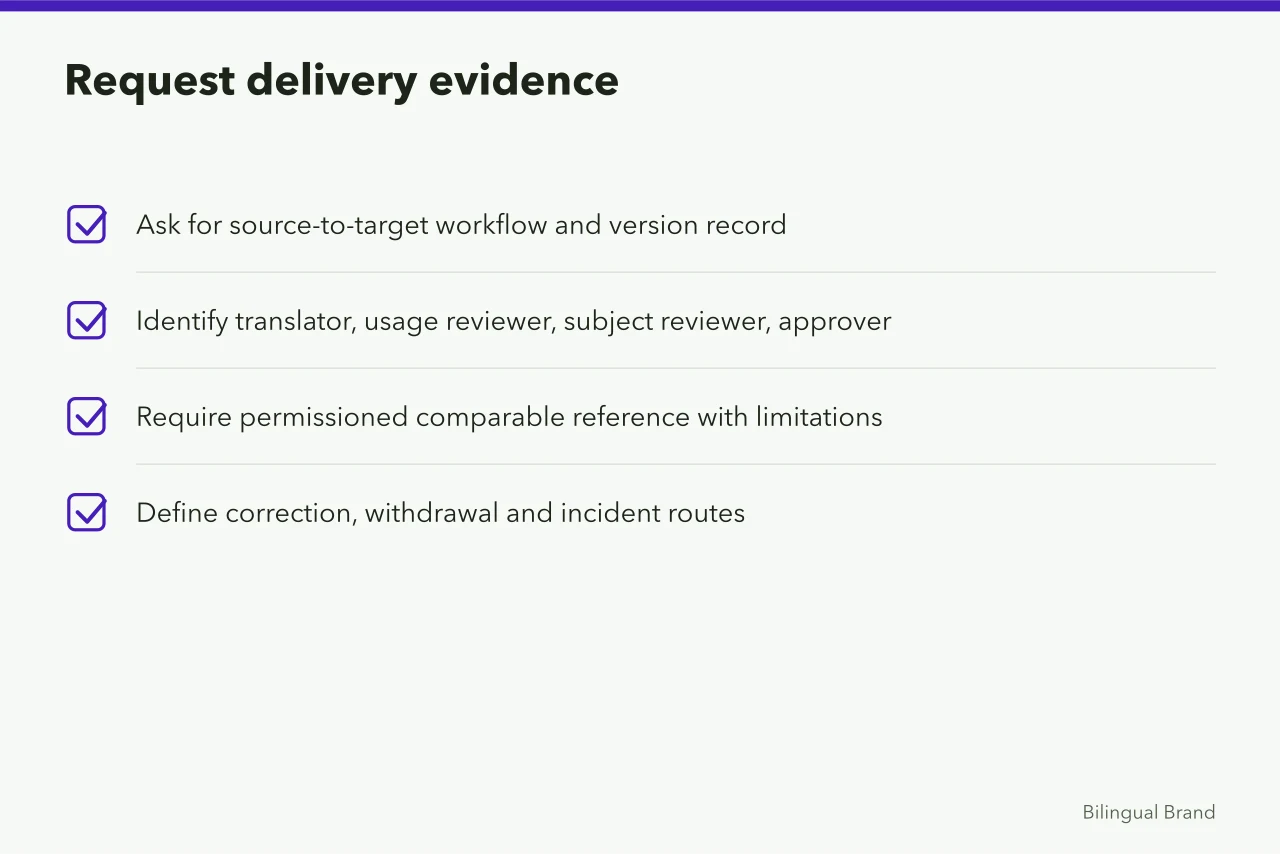
- Ask for the source-to-target workflow and the version record behind it.
- Name the translator or localiser, the usage reviewer, the subject reviewer and the final approver.
- Require a permissioned comparable reference with service, date, definitions and limits.
- Define correction, withdrawal and incident routes.
The record should show who changed wording after approval and when. Our intake to exit workflow shows how those roles hand work on with owners attached.
Step 4: keep risk gates independent
- Trace every objective claim to buyer-approved substantiation, using the CAP Code's misleading-advertising section.
- Test captions, contrast, reading order, controls and landing content in the final rendering.
- Map purpose, roles, lawful basis, retention and rights handling for qualified review.
- Record licences for source copy, translations, terminology, creative and model inputs.
- Verify platform and automation permissions separately from the supplier contract.
No certificate, disclosure control or platform approval clears another line. For data roles, read the ICO guidance on contracts and liabilities between controllers and processors and check the page's own update note before relying on any summary.
Step 5: compare complete commercial units
- Require the service edition, currency, VAT basis, unit quantity and quote date.
- Include language work, subject review, accessibility, media and exit help.
- Record ownership, portability, termination help, export format and deletion proof.
- Leave unsupported values blank instead of estimating a market norm.
Our contract terms checklist covers named parties through to exit. Reject a contract that expressly refuses a required right or export.
Example: a completed acceptance gate
The record below is illustrative, with no client named.
Completed acceptance gate
- Source asset
- Approved launch carousel, version 4, synthetic content
- Reviewers
- Translator, usage reviewer, subject reviewer, accessibility reviewer, privacy reviewer
- Exports
- Version record, terminology list, accessibility report
- Stop conditions
- Unapproved claim, missing caption, personal data in the asset
- Decision
- Hold, with owner and date entered in the log
What editorial-draft-hold means here
editorial-draft-hold labels this page, not your procurement. It means the checklist text is still waiting on named specialist sign-off. It leaves that state when the language, privacy and advertising reviewers have each recorded a versioned approval.
Common questions
Which gate stops most weak proposals?
The request gate. If bidders are answering different briefs, no later comparison is meaningful, so close the brief before ranking anyone.
How do I check a supplier's UK legal entity?
Search the company number on the Companies House register, then read the filing history and registered office. That record proves identity and filings only. It does not prove social-marketing competence, insurance cover or reference permission.
What goes into the acceptance gate record?
The asset version, each reviewer and their lane, the exports expected, the stop conditions, and the decision with its expiry trigger. Name one owner per row.
When does hold become reject?
When a gap stays open past the date you set, or when closing it needs a right the supplier has already refused. Note both reasons in the log.