

Reviews
How to review multilingual social marketing providers and products through gates that do not compensate
A method for reviewing multilingual social marketing providers and products through gates on identity, language, accessibility, privacy, security, rights and exit.
Public information can help an England buyer reject weak multilingual social marketing proposals. It rarely proves an agency or product suitable.
A useful review makes one of three decisions: admit the candidate to a configured test, hold it while evidence is missing, or reject it when a non-negotiable condition fails. It does not make marketing pages a league table.
This guide was researched from England and UK official material plus dated supplier records on 6 September 2026. Bilingualbrand.co.uk performed a desk review only. The writer, fact-checker and qualified reviewers remain to be assigned, there was no supplier funding, and no service, software, language output, security control or campaign result was tested. The publication status remains HOLD.
What to take away
- A review should admit, hold or reject a candidate, not rank marketing pages.
- Non-compensating gates prevent a weighted total from hiding a serious failure.
- Public records can reject a weak proposal but rarely prove suitability.
- Desk research should lead to a permissioned test, not a published claim.
- The buyer owns the test design and the decision record.
Decide what is being reviewed
Begin with the buyer's actual job, not a supplier category. Specify the England audience, self-described language and format need, source claim, channel, asset type, decision date and acceptable release evidence. Do not infer language, literacy, ethnicity, culture, vulnerability or purchasing intent from a name, postcode or profile field.
Pick the review object
What is the buyer's actual job?
Agency or managed service -> check entity and subcontractors
Named language route -> translation, transcreation, original production
Then identify the review object precisely:
- an agency or managed service, including the legal entity and subcontractors;
- a named language-service route, such as translation, transcreation or original-language production;
- an exact software product and edition;
- a combined delivery chain, with responsibility at each hand-off.
These objects are not interchangeable. The Government Commercial Agency's current Language Services agreement RM6302 separates managed, regional, transcription, visual and overseas interpreting lots. That UK public-sector framework is evidence of a procurement route and recorded suppliers, not an independent finding about social marketing competence or fitness for a private buyer.
Publish the review record before the verdict
A reproducible review names the reviewing body, reviewer status, subject and version, research cut-off and geography. It states the searched source universe, admission rules, exclusions, conflicts and funding. It also says what was opened, what was tested and what could not be observed.
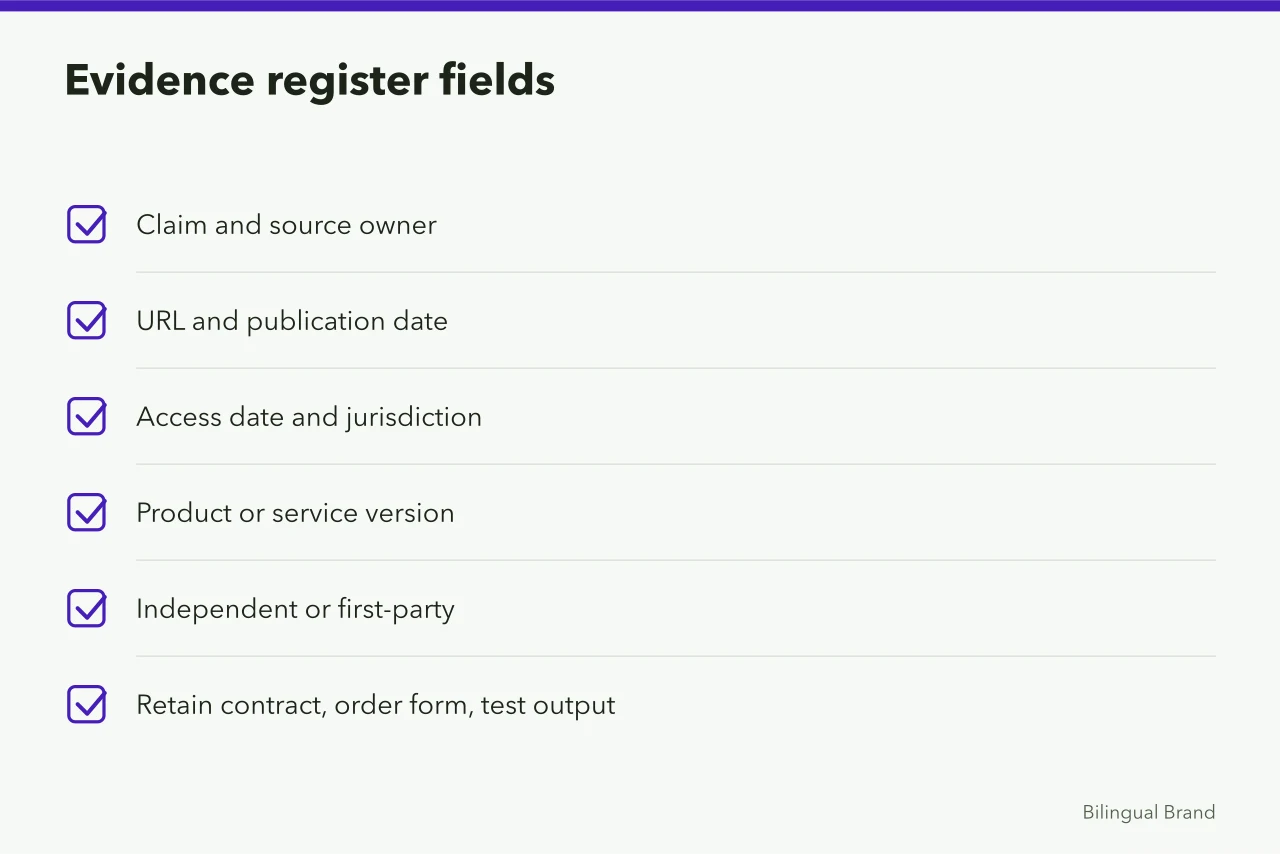
Use a dated evidence register. For each statement, record the claim, source owner, URL, publication or effective date, access date, jurisdiction, product or service version, and whether it is independent or first-party. Screenshots may preserve a volatile page, but the buyer should also retain the contract, order form and test output that actually governed the decision.
Evidence hierarchy
Rank
- 1
- Permissioned task evidence
- 2
- Official primary records
- 3
- First-party documents
- 4
- Case studies and badges
Evidence type
- 1
- Strongest
- 2
- Strong
- 3
- Supporting
- 4
- Attributed only
Use
- 1
- 2
- 3
- 4
- Permissioned evidence produced for the buyer's configured task, including source text, reviewer record, accessibility check and acceptance result.
- Primary official records, such as legislation, regulator material, public registers and an applicable procurement notice.
- Current first-party product, security, privacy, contract and support documents.
- Supplier case studies, testimonials, badges and promotional claims, kept as attributed assertions only.
An absence in a public record is not proof that a capability is absent. It is an unknown that may justify HOLD.
Use non-compensating admission gates
A weighted total can conceal a serious failure. Treat the following gates separately as Pass, Hold, Reject or Not applicable, with evidence and an owner for each decision.
Non-compensating admission gates
- Identity, authority and delivery chain
- Claims traced to approved source
- Language work role defined
- Native-level and subject review
- Accessibility and legal acceptability
- CAP Code rule 3.7 evidence held
Identity, authority and delivery chain
Confirm the legal entity that will contract, invoice and process data. Companies House can verify a UK company's recorded identity and filing status, but it does not establish linguistic competence, service quality or solvency. Obtain the subcontractor chain, location of work, account authority and named escalation contacts from the bidder.
Claims and language work
Trace each marketing claim to an approved source. Define whether the supplier will translate, localise, transcreate or create new copy. Require an appropriate professional translator or localiser, native-level review for the target usage, and subject review where the topic demands it. None of these roles proves the work is accessible or legally acceptable.
Before publication, CAP Code rule 3.7 says marketers should hold documentary evidence for objective claims that consumers are likely to regard as capable of substantiation. The CAP misleading-advertising rules apply across UK non-broadcast marketing, including relevant social content. A supplier's confident wording is not the buyer's substantiation.
Accessibility and equality
Test the final rendered post, landing route, captions, reading order and interaction, not merely the source file. GOV.UK's inclusive communication guidance is government communication guidance rather than a universal private-sector specification, but it is a useful prompt to identify audience barriers and alternative formats. Qualified accessibility and equality review must address the actual service.
Privacy, PECR and research permissions
Map personal data, purposes, roles, sources and recipients. Map retention, transfers, rights handling; treat research participation, direct marketing and audience targeting as separate decisions.
The ICO's direct marketing guidance is UK guidance, marked for updates after the Data (Use and Access) Act; recheck it at release; do not assume a supplier's platform setting chooses a lawful basis or clears PECR.
Where a provider processes personal data, compare the proposed terms with the ICO's controller and processor contract guidance. That page is also under review following statutory change. A contract is evidence of allocated duties, not proof that the real workflow follows them.
Security and continuity
Document least-privilege access, account ownership, authentication, logs, incident contacts, recovery, export and deletion. The NCSC's supply-chain security principles advise organisations to understand and manage risks across suppliers. A certificate can inform assurance, but it cannot replace a configured access test, incident exercise or exit rehearsal.
Intellectual property and platform permission
List ownership and permitted uses for source copy, translations, glossaries, memories, model inputs, creative assets and output. GOV.UK's copyright overview explains that copyright protection arises automatically for original work in the UK. It does not resolve ownership or licence terms for a particular commissioning chain. Confirm platform access and automation permissions separately.
Commercial terms and total cost
Compare the same deliverable, language pair, source unit, review depth. Check same period, service boundary. Record licence/service fees, usage units, professional language work, subject review, accessibility. Record media, support, security assurance, tax treatment, overages. Record remediation, renewal, exit. Blank unknown values pending a dated quote.
A lower visible subscription price cannot compensate for a failed rights, privacy or evidence gate.
Test one configuration without inventing experience
Desk research should lead to a permissioned acceptance exercise, not a published claim that the product was tested. Use synthetic or approved non-production content representing the real formats and risk. Predefine expected artefacts, named reviewers, acceptance criteria and rejection conditions.
A sensible sequence is:
- Verify identity, contract route, data roles and rights before granting access.
- Ask the candidate to process one bounded source asset through the proposed route.
- Inspect version history, terminology handling, hand-offs and export.
- Obtain independent professional, subject and accessibility reviews of the final rendering.
- Exercise correction, withdrawal, access removal, export and deletion evidence.
Do not score fluency by asking an unqualified stakeholder whether copy sounds right. Do not treat machine confidence, supplier quality labels or a clean spellcheck as a professional language conclusion. The buyer owns the test design and the decision record.
Compare providers without inventing a winner
For an agency comparison, require a dossier for the same buyer task: legal identity, service definition, named delivery roles, language and subject-review method, and permissioned reference evidence.
Add accessibility approach, data map, security evidence and contract. Then complete price unit and exit plan.
If an agency will not provide a permissioned reference or bounded sample, record the missing evidence rather than inferring competence from website clients.
Public-sector framework membership, a directory listing or Companies House status can support a dossier but does not prove a best provider. A testimonial is a supplier-selected account, not independent comparative evidence.
The CMA's current guidance for businesses and agencies covers honest, transparent reviews and endorsements in the UK. Commercial relationships and incentives should be visible in the review record.
If all candidates clear the admission gates, compare only the remaining buyer-owned trade-offs. These might include supported source formats, review workflow, operational fit, evidence export, service boundary and whole-life cost.
Publish no numerical winner unless every input is comparable, the weighting was fixed in advance and the result is strong to plausible changes. Often the honest result is a conditional shortlist or no decision.
Compare products by exact edition and task
Product records change. Name the product, plan or edition, geography, currency and billing basis where relevant, source date and access date. Separate features documented by the vendor from controls verified in the buyer's environment. Preserve unknowns about data location, subprocessors, accessibility, support, export, deletion and renewal until the applicable terms and configuration have been examined.
A translation management product may document terminology, workflow and export features. That does not prove it can produce an acceptable social advert, that a particular edition includes the capability, or that using it meets UK privacy and advertising requirements.
Compare a no-new-product baseline too: buyer-controlled source files, glossary, change log, secure transfer and manual approvals. It may be operationally heavier, but it stops procurement momentum becoming the decision criterion.
Write a bounded verdict
A defensible conclusion is configuration-specific. It states the task, evidence date, candidates admitted, gates cleared, unresolved points and next test. Use precise language:
- Pass to test:public and supplied records are sufficient for a controlled acceptance exercise.
- Hold:a material record, qualified review or configured test is missing.
- Reject:a stated non-compensating condition failed or the supplier declined it.
The verdict expires when the service, edition, subcontractor, data flow, terms, law, buyer task or reviewer changes. Assign an owner and update trigger rather than promising an annual refresh.
Publication decision
This guide remains editorial-draft-hold. Before release, appoint the writer, fact-checker and named UK-qualified reviewers for translation, accessibility, privacy and PECR, advertising and consumer claims, intellectual property, security, contract and finance questions. Re-open every source, document conflicts, and remove any conclusion whose supporting configuration cannot be reproduced.
Before you act
- Define the buyer's actual job and review object precisely.
- Publish a dated evidence register before the verdict.
- Treat each admission gate separately as Pass, Hold, Reject or Not applicable.
- Test one configuration with permissioned, non-production content.
- Compare providers using a dossier for the same buyer task.
Common questions
What three decisions can a useful review reach?
A useful review reaches one of three decisions: admit the candidate to a configured test, hold it while evidence is missing, or reject it because a non-negotiable condition has failed. It does not turn marketing pages into a league table.
Why should admission gates be non-compensating?
A weighted total can conceal a serious failure. Treat each gate separately as Pass, Hold, Reject or Not applicable, with evidence and an owner for each decision. A lower visible subscription price cannot compensate for a failed rights, privacy or evidence gate.
What should a desk review lead to?
It should result in a controlled acceptance exercise with the buyer's permission, not a public claim that testing has happened.
In this guide
- What public records can prove about multilingual social providersRead public records on multilingual social marketing providers: what Companies House, a framework listing and a supplier's own words can and cannot show.
- Translation workflows for multilingual social postsNo multilingual social marketing product comparison yet: the eight workflow steps of one social post through Phrase TMS, Lokalise or a manual route.
- Multilingual social marketing agency reviews: why noneWhy Bilingualbrand.co.uk has no completed multilingual social marketing agency reviews, what public records show and what a future review would need.
- Selecting a multilingual social route with pass, hold and reject rulesSelect a multilingual social marketing route with evidence requests, non-compensating review gates and explicit pass, hold and rejection rules.