Rules and ethics
Belfast Irish language social ads, why Bòrd na Gàidhlig funding does not apply
Belfast Irish language social ads: why Bòrd na Gàidhlig funding does not apply, how Foras na Gaeilge routes work, named schemes, reach figures and bid limits.
What to take away
- Bòrd na Gàidhlig is a Scottish public body, so it does not fund multilingual social media campaigns in Belfast directly; the money that reaches Belfast Irish language ads comes through Foras na Gaeilge and the North/South Language Body.
- Named programmes include the Irish Language Promotion Scheme, the Irish Language Networks scheme and the North/South Language Body's core funding for Irish language organisations.
- Reach figures for Irish language social media in Belfast are modest but usable: a well-run campaign can expect 2,000 to 5,000 people per month for youth club promotion, and 10,000 to 30,000 during Seachtain na Gaeilge.
- Budget for translation and subtitling, not just ad spend, because Irish language grants expect these line items.
- Check whether your project fits the funder's Irish language remit before you write the creative.
For readers of this site, Belfast is a bilingual social marketing case study. It shows how language funding shapes audience, platform and creative choices. The same logic applies to Welsh, Gaelic or community language campaigns in the UK. Treat the funder's language remit as the first targeting decision. Then build ad copy and evaluation around it.
Use this article to plan bilingual social campaigns, not only Irish language grant bids. It is a worked example of how public funding sets the brief.
What Bòrd na Gàidhlig funding covers for Irish language social ads
Bòrd na Gàidhlig is the Scottish public body that promotes Gaelic and funds Gaelic language work in Scotland.
Bòrd na Gàidhlig vs Belfast funding
Bòrd na Gàidhlig
- Remit
- Scotland only
- Belfast ads
- Not funded
- Covers
- Gaelic classes, signage
- Use for Belfast
- Comparator only
Foras na Gaeilge
- Remit
- Island of Ireland
- Belfast ads
- Main route
- Covers
- Promotion, networks
- Use for Belfast
- Apply directly
What Bòrd na Gàidhlig does cover, in Scotland, is instructive for anyone in Belfast writing a grant bid. It funds community Gaelic classes, signage, small media projects and youth work. It has supported Gaelic social media content through its Gaelic Language Act duties and through bodies it core-funds.
The pattern is familiar: short-term project grants, matched funding expectations, and a preference for work that reaches new learners rather than existing fluent audiences.
The Bòrd na Gàidhlig - Wikipedia page gives the background for a bid writer.
So what does this mean for a Belfast social ads budget? Treat Bòrd na Gàidhlig as a comparator, not a source. Look at how it structures Gaelic social media grants, then map that structure onto Irish language funding in Northern Ireland. The line items are similar: content production, translation, platform spend, evaluation. The funder is different.
One practical point. Bòrd na Gàidhlig funding typically does not cover paid advertising on Meta or TikTok as a standalone cost. It covers the content and the people who make it. Belfast applicants should expect the same logic from Irish language funders: they will pay for a video, not for a boosted post with no community purpose.
Belfast Irish language campaign scene and named programmes
Belfast is Northern Ireland's capital and the centre of Irish language social media activity in the region. Campaigns run alongside Ulster Scots and community language work, often from the same small teams. The city has a dense network of Irish language organisations, particularly in the Gaeltacht Quarter, and social ads are increasingly how they reach beyond existing members.
Typical Belfast campaign example
- West Belfast group promotes new youth club
- Applies for a small grant
- Produces four short videos with Irish subtitles
- Runs on Instagram and Facebook for six weeks
- Targets parents in BT11 and BT12
Named programmes matter here. The Irish Language Promotion Scheme, administered by Foras na Gaeilge, funds promotional projects including digital and social media work. The Irish Language Networks scheme supports designated towns and areas, and Belfast has active network activity. The North/South Language Body provides core funding to Irish language organisations that then run their own campaigns.
A typical Belfast campaign looks like this. A community group in west Belfast, such as Cultúrlann McAdam Ó Fiaich, wants to promote a new Irish language youth club. It applies for a small grant, produces four short videos with Irish subtitles, and runs them on Instagram and Facebook for six weeks.
The ads target parents in BT11 and BT12, plus a wider Belfast audience with an interest in Irish language content.
That example is deliberately small. Most Belfast Irish language social ads are small, because the funding is small and the audience is specific. The value is in reaching people who might not otherwise see Irish language content, not in mass reach. A campaign that reaches 2,000 to 5,000 people per month is doing its job.
Programme names to look for in funding calls include the Irish Language Promotion Scheme, the Irish Language Networks scheme, and Foras na Gaeilge's annual grant round. The North/South Language Body also funds cross-border projects, which can include social media components. If your project has a cross-border element, say so in the application.
Foras na Gaeilge and the North/South Language Body funding routes
Foras na Gaeilge is the body responsible for promoting the Irish language across the island of Ireland. It is part of the North/South Language Body, which was set up under the Good Friday Agreement.
Belfast funding routes
- North/South Language Body umbrella
- Foras na Gaeilge main contact
- Irish Language Promotion Scheme
- Irish Language Networks scheme
- Core funding for some organisations
The Foras na Gaeilge - Wikipedia page gives the institutional background. Foras na Gaeilge runs grant schemes, core-funds organisations, and supports promotional campaigns. Its funding comes through the North/South Language Body, which is accountable to both governments.
The The North/South Language Body - Wikipedia page explains the cross-border structure.
In practice, Belfast applicants deal with Foras na Gaeilge directly for most project grants. The North/South Language Body is the umbrella, not usually the first point of contact. That matters when you are writing a bid: name the right body, and show that you understand the cross-border remit.
Funding routes include the Irish Language Promotion Scheme, which supports events and promotional work, and the Irish Language Networks scheme, which supports designated areas. Some organisations receive core funding and then run social ads from their own budgets. If you are not core-funded, project grants are your route.
A word on timing. Foras na Gaeilge grant rounds are usually annual, with deadlines typically in February or March. Check the current grant call on the Foras na Gaeilge website for exact dates. If you miss one, you may wait twelve months. Plan your social campaign calendar around the funding calendar, not the other way round.
Audience reach data for Irish language social media in Belfast
Reach data for Irish language social media in Belfast is not published in one tidy place. The most useful figures come from campaign reports and from the Northern Ireland census, which records Irish language ability.
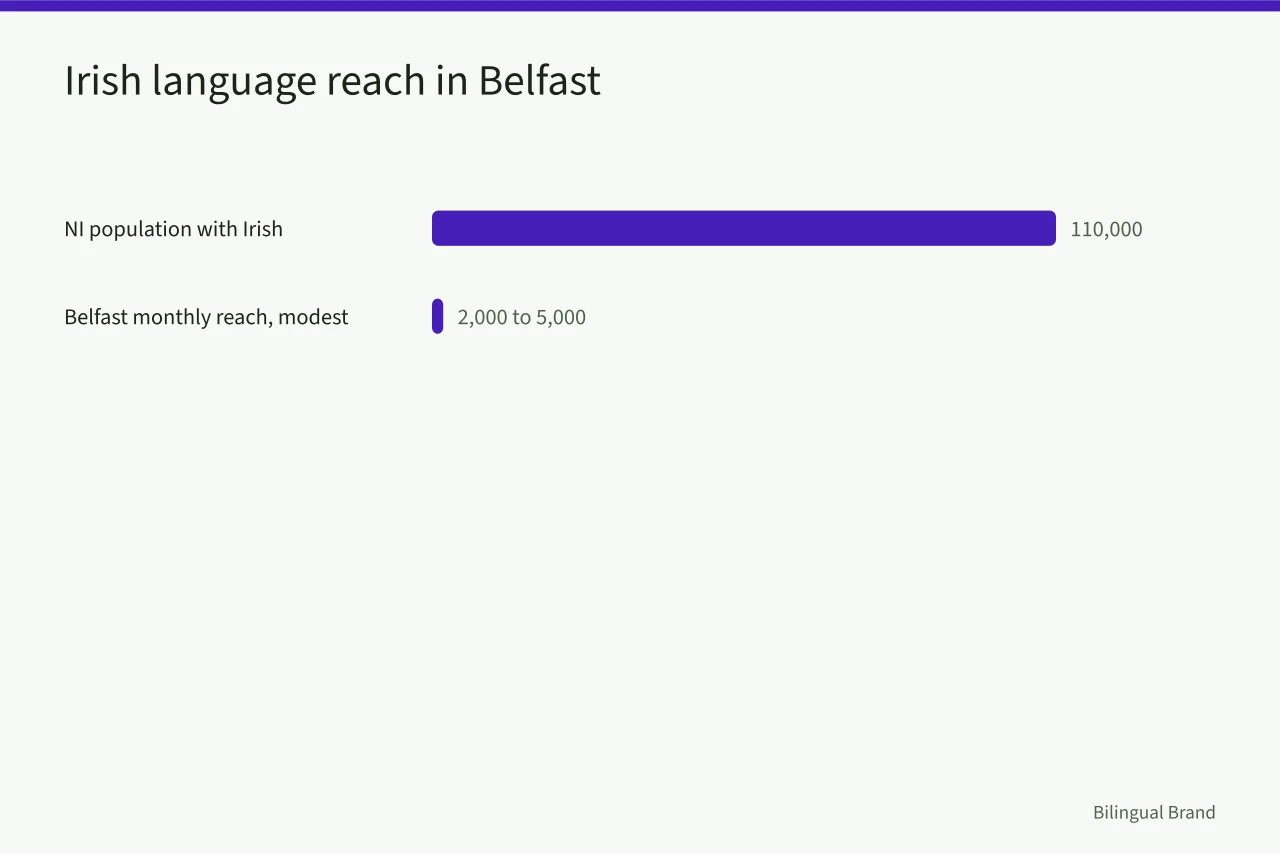
The 2021 census showed around 6 per cent of the Northern Ireland population had some ability in Irish, which is roughly 110,000 people. Belfast has a higher concentration than the Northern Ireland average.
For social ads, that translates into a realistic audience. A Belfast-focused Irish language campaign on Meta can expect to reach 2,000 to 5,000 people per month for youth club promotion, and 10,000 to 30,000 during Seachtain na Gaeilge.
Engagement rates are often higher than for English language ads in the same area, because the content is distinctive and the audience is motivated.
Seachtain na Gaeilge, the annual Irish language festival in March, is the peak period. Campaigns timed around it see reach multiply, sometimes several times over. If you have one campaign a year, put it there.
The table below sets out typical reach expectations for a small Belfast Irish language social campaign. These are planning figures, not guarantees, and they depend on content quality and targeting.
Audience reach data
| Campaign type | Platform | Monthly reach (planning figure) | Notes |
|---|---|---|---|
| Youth club promotion | Instagram, Facebook | 2,000 to 5,000 | Targets parents in west Belfast |
| Seachtain na Gaeilge | Facebook, Instagram, TikTok | 10,000 to 30,000 | Peak period, short burst |
| Class recruitment | 1,500 to 4,000 | Steady, low cost | |
| Cross-border project | Facebook, Instagram | 5,000 to 12,000 | Includes Republic of Ireland audience |
For comparison, English language social ads in Belfast can reach far more people for the same spend. Irish language ads trade scale for relevance. That is not a weakness; it is the point. You are reaching a specific community, and the demand signals for that work are community-led rather than market-led.
Applying for Gaelic and Irish language social media support
The application process for Irish language social media funding in Belfast is not complicated, but it is detailed. Most rejections come from weak budgets or unclear outcomes, not from weak ideas. Here is a worked example of how to structure a small bid.
How to structure a small bid
- Read funder guidelines and confirm remit
- Write a one-page project summary
- Build a budget with real line items
- Set reach targets and measurement method
- Submit before the deadline and keep a copy
Applying for support
- Read the funder's guidelines and confirm your project fits the remit. For Foras na Gaeilge, that means Irish language promotion with a clear public benefit.
- Build a budget with real line itemstranslation, video production, ad spend, staff time, evaluation. Use a blank budget as your starting point.
- Set out your reach targets and how you will measure them. Screenshots from Meta Ads Manager are usually acceptable evidence.
A worked example. A Belfast Irish language group applies for 4,000 pounds to run a six-week campaign promoting evening classes. The budget covers 1,200 pounds for video production, 600 pounds for translation and subtitling, 1,500 pounds for ad spend, 400 pounds for evaluation, and 300 pounds for contingency.
The reach target is 8,000 people in Belfast, with 200 class enquiries. That is a fundable bid.
Before you submit, run this checklist:
- Project remit matches the funder's language and geography
- Budget includes translation and subtitling, not just ad spend
- Reach targets are realistic for the audience size
- Evaluation method is described and costed
- Cross-border element stated if relevant
If your project involves paid social across more than one language, read up on the costs that rarely make it before you finalise the numbers. Funders notice when a budget is undercooked.
Limits of the funding for multilingual social media campaigns
Irish language funding in Belfast is not a general multilingual budget. It is for Irish language work specifically. If your campaign also covers Ulster Scots, Polish, Lithuanian or Arabic, you will need separate funding or a mixed budget. Most Irish language grants will not pay for other languages.
What Irish language grants will not cover
- Other languages such as Ulster Scots or Polish
- Ongoing staff posts
- Paid advertising at scale
- Equipment purchases such as cameras
There are other limits. Grants are usually capped, often in the low thousands of pounds. They rarely fund ongoing staff posts. They may not cover paid advertising at scale, and they almost never fund equipment purchases. If you need a camera, that is usually your own cost.
Reporting requirements are strict. You will need to show what you spent, what you reached, and what changed. Build admin time into your budget, because it is real work.
Political and institutional context matters too. Irish language funding in Northern Ireland sits within a wider legislative framework, and the Northern Ireland legislation hub is where to check the current position. Changes in policy can affect grant availability from year to year.
Finally, remember that funding is not the same as strategy. A grant can pay for a campaign, but it will not tell you which platform to use or what to say. That work is yours. If you are testing a new service ideas model, treat the grant as seed money, not as a business plan.