

Costs and pricing
Part of Evidence to keep for each multilingual social budget line
Comparing multilingual marketing pricing structures on risk, not on one invoice line
Compare multilingual marketing charging structures on one England project unit, with risk allocation, complete scope, blank prices and no cheapest claim.
Comparing multilingual marketing pricing structures on risk, not on one invoice line
Multilingual social marketing pricing models allocate quantity, time and change risk differently. They do not show which option is cheapest until the buyer fixes one comparable scope and fills it with current evidence.
What to take away
- Pricing structures move quantity, time and change risk to the buyer in different ways.
- Convert each bid into a workload schedule before comparing headline figures.
- No cheapest option can be named until the buyer supplies figures for one comparable scope, currency and VAT status.
- A pricing mechanism does not prove translation quality, accessibility, compliance or performance.
Comparison method
Bilingualbrand.co.uk reviewed official, first-party records on 6 September 2026. Common unit: one approved source campaign, one self-described target-language need, a defined asset set, qualified translation, native-level and subject review. Plus accessible rendering, publishing control, evidence retention, correction and exit over the same period.
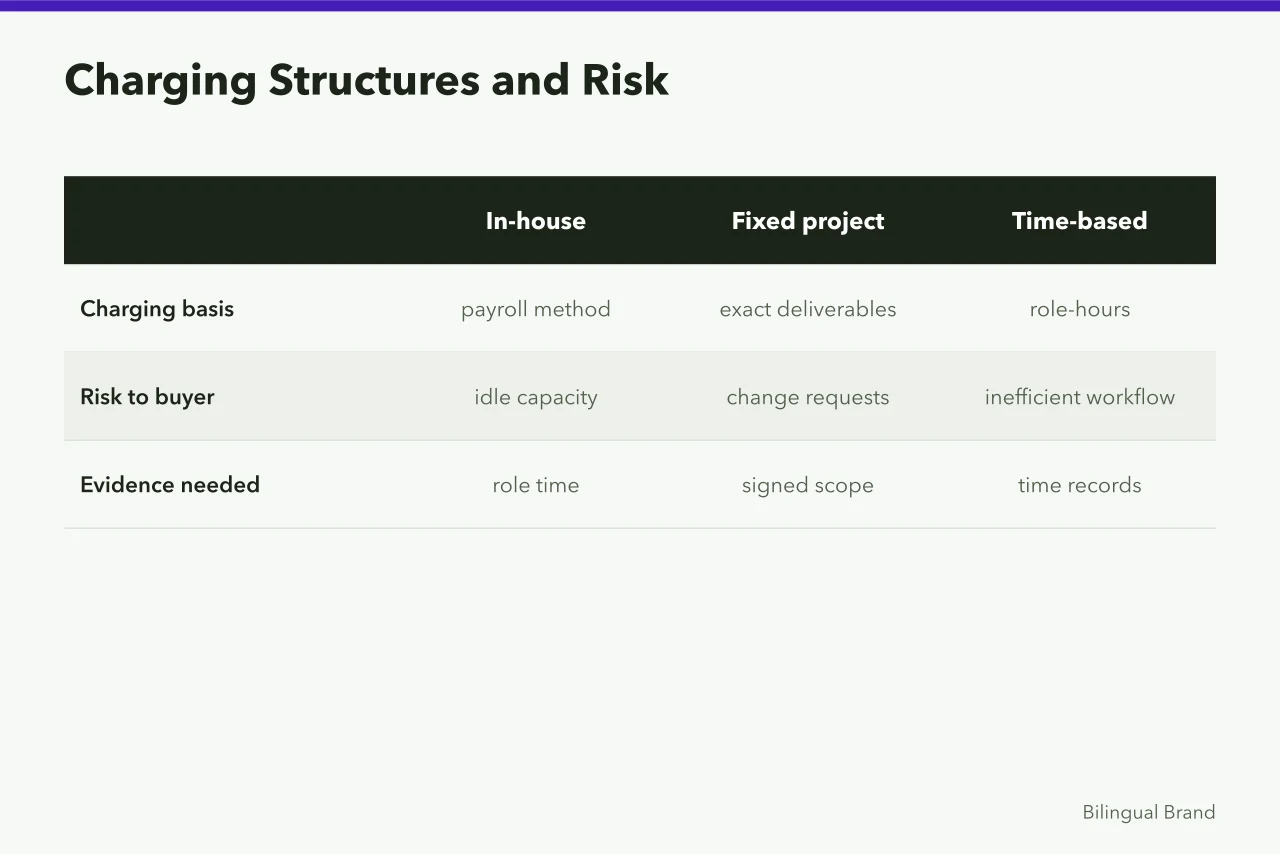
In-house allocation, fixed project and time-based, language unit, software subscription plus usage, and managed service were included for materially different charging rules. Media commissions and outcome fees were excluded as they do not cover the complete unit, and the work is desk-only, unfunded and non-ranked.
Charging basis to request
- In-house allocation
- approved payroll and internal-resource method
- Fixed project
- exact deliverables and acceptance period
- Time-based service
- role-hours under a stated clock
- Language unit
- source or target unit by content class
- Subscription plus usage
- edition, users, usage unit and commitment
- Managed service
- service bundle and governance period
Risk that moves to buyer
- In-house allocation
- idle capacity, absence, tooling and supervision
- Fixed project
- change requests, excluded formats and extra revisions
- Time-based service
- inefficient workflow and uncertain volume
- Language unit
- minimums, expansion, non-text work and rework
- Subscription plus usage
- underuse, overage, integration and renewal
- Managed service
- dependency, subcontracting and opaque pass-throughs
Evidence needed
- In-house allocation
- role time, employment cost basis, utilisation and quality record
- Fixed project
- signed scope, assumptions, variation and cancellation rules
- Time-based service
- approved roles, time records, cap and stop authority
- Language unit
- count method, exclusions, review depth and version history
- Subscription plus usage
- order form, usage export, support and exit terms
- Managed service
- delivery schedule, labour breakdown, rebates, data and transition plan
Named public structures for multilingual content and social campaigns include Smartcat Team at $99 per month, Crowdin Pro at $50 per month and Team at $250 per month, and Gengo Standard at $0.09 per word and Pro at $0.18 per word. These are list prices, not England quotes.
For memoQ TMS, thebigword and LanguageLine Solutions, no public England rate card exists for this scope. Request a written range and treat it as supplier-specific, not a typical market range.
No single England price is supplied by these records. Put each option into the same currency, VAT status, billing period and complete workload before comparing.
Convert each bid into a workload schedule rather than one headline figure. For every month or project phase, show planned units, included capacity, expected unused capacity, overage rule, buyer labour and external review. Mark a cost fixed only for the contractual scope and period.
A fee can still vary when the buyer changes languages, formats, deadlines, platforms or evidence requirements.
Worked schedule, illustrative only and not a quote. It uses one approved campaign, 20 posts, 4 target languages and 2 review rounds.
| Month | Planned units | Included capacity | Expected unused capacity | Overage rule | Buyer labour | External review |
|---|---|---|---|---|---|---|
| Month 1 | 80 post-language units | 80 units | 0 | added language billed at agreed unit rate | 10 hours at the 2025 National Living Wage rate of £12.21 an hour for workers aged 21 and over, £122.10 before employer costs | 8 hours native review, quoted separately |
| Month 2 | 24 post-language units | 80 units | 56 units | unused units do not roll over | 4 hours at the same rate, £48.84 before employer costs | 4 hours native review, quoted separately |
The GOV.UK National Living Wage rate is a public labour floor. It is not a supplier quote. The schedule shows why a headline fee and a unit rate are not comparable until the same scope is filled with buyer figures.
What current records can establish
The memoQ TMS plan page and Smartcat's TMS page establish that named plans use subscriptions or usage credits. They do not establish a final England price, a suitable edition or a complete service.
The Government Commercial Agency Language Services framework distinguishes managed and translation-support routes and publishes separate pricing and call-off schedules. It applies to eligible public and third-sector buyers, not every organisation. Its structure cannot be copied as a private quote or a market average.
England-based examples include thebigword and LanguageLine Solutions. Any England rate depends on language, volume, service level and term, so no single rate is comparable. The GCA call-off schedule is the public England rate card to request for the same scope.
Compare complete risk, not one invoice line
Ask who pays for source preparation, terminology, translator labour, native-level review, subject clearance, creative adaptation, accessibility, research, media, publishing, privacy, security, claims review, IP permission, support, remediation and exit. Record exchange basis, VAT, minimums, commissions, rebates, credits, pass-through spend, renewal and termination.
Risk Allocation Questions
- Who pays for source preparation?
- Who pays for terminology?
- Who pays for translator labour?
- Who pays for native-level review?
- Who pays for subject clearance?
- Who pays for creative adaptation?
- Who pays for accessibility?
Assign risk explicitly. Under a unit model, the buyer might retain uncertain volume; the supplier may price a clearly bounded delivery risk into a fixed project. Time-based work needs a buyer-approved cap and pause point.
Employment and tax treatment needs its own gate. GOV.UK notes in its self-employed contractor guidance that tax and employment status may differ. A contract label is not enough.
A subscription needs usage evidence and a renewal decision before notice expires. A managed service needs transparent subcontractor, media-payment and technology-charge records. These are contract questions, not assumptions about supplier conduct.
Test the decision with the same evidenced changes in asset count, revision burden, support use and exit effort. If a small change reverses the preferred structure, report that sensitivity. Do not hide it by averaging scenarios.
If a single recommendation is needed, choose a capped time-based or managed service with usage evidence for uncertain monthly volume. Choose a fixed project with a clear variation rule for a fully specified campaign. Withhold a winner if scopes, units or evidence remain unlike-for-like.
The right output may be a request for revised quotes, a limited pilot or a manual baseline.
Pre-quote checklist
- Ask for the GCA call-off schedule and any England supplier rate card for the same scope.
- Fill the worked schedule with your own volumes, languages and review rounds.
- Check who pays for a change in asset count, formats, deadlines or platforms.
- Ask for the exit notice, data return date and unused-capacity rule in writing.
Common questions
What common unit should buyers use to compare multilingual marketing pricing structures?
The common unit is one approved source campaign with a defined asset set and target-language need. It covers qualified translation, native-level and subject review, accessible rendering, publishing control, evidence retention, correction and exit over the same period.
Why are media commissions and outcome fees excluded from the comparison?
Media commissions and outcome fees were excluded because they do not cover the complete unit. The comparison focuses on structures that use materially different charging rules for the full scope, including in-house allocation, fixed project, time-based, language unit, subscription plus usage and managed service.
What should a buyer do if a small change reverses the preferred structure?
If a small change reverses the preferred structure, report that sensitivity. Do not hide it by averaging scenarios. The article advises testing the decision with the same evidenced changes in asset count, revision burden, support use and exit effort.